Einstein's Sea Test!

Mukesh Kumar
| 20-11-2026
 · Astronomy Team
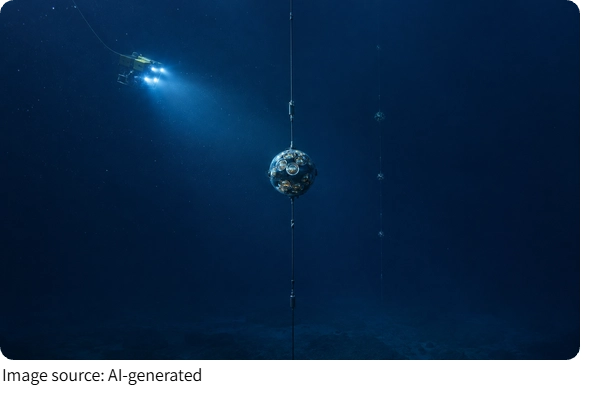
A scientific instrument resting deep beneath the Mediterranean Sea has helped researchers examine one of the most important ideas in modern physics. Positioned approximately 1.5 miles (2.4 kilometres) below the surface near Toulon, France, the underwater telescope was designed to detect neutrinos, tiny particles that can travel through enormous distances with very little interaction with matter.
Its measurements have now been used to test whether the laws of nature behave consistently across different directions and conditions, as predicted by Einstein’s theory of relativity.
Testing a Fundamental Rule of Physics
The experiment focused on a principle known as Lorentz invariance. In simple terms, it means that the basic laws of physics should remain the same regardless of an observer’s direction or state of motion. This assumption is central to Einstein’s theory of relativity and also plays an important role in the Standard Model, which describes the behaviour of fundamental particles.
However, physicists still have questions about how the two frameworks fit together under extreme conditions. Some proposed approaches to quantum gravity suggest that space-time might have an underlying structure at incredibly small scales. If that idea is correct, Lorentz invariance might not be perfectly preserved.
Why Neutrinos Are Useful
Neutrinos have almost no mass and carry no electric charge. They pass through Earth and other matter with very little interaction, making them difficult to detect. Scientists recognise three main types: electron, muon and tau neutrinos.
As they travel, neutrinos can transform from one type into another. This process is called neutrino oscillation, and it follows patterns that physicists can predict. A possible violation of Lorentz invariance could affect those patterns. The longer neutrinos travel, the more noticeable such an effect might become. This makes particles arriving from far across the planet valuable for testing the principle.
The researchers examined neutrinos produced when cosmic rays collide with particles in Earth's atmosphere. Some travelled upward through the planet before reaching the underwater detector, covering distances of up to approximately 7,900 miles (12,700 kilometres).
How the Underwater Telescope Works
The instrument, called Oscillation Research with Cosmics in the Abyss, or ORCA, forms part of the larger KM3NeT neutrino telescope project. Its detection units are anchored to the seabed and contain 18 glass spheres. Each sphere houses 31 light sensors designed to register extremely faint flashes. When a neutrino interacts with a particle in the surrounding water, the interaction can produce a small amount of blue light.
The surrounding Earth also helps researchers separate useful signals from background interference. By selecting particles travelling upward through the planet, the team could reduce the number of other atmospheric particles reaching the detector. This arrangement differs from IceCube, a neutrino observatory installed in Antarctic ice. Water and ice affect light differently: ice scatters light more strongly, while water absorbs more of it. As a result, each facility uses its own methods to reconstruct particle paths and energies.
What the Measurements Revealed
For the study, researchers analysed 5,828 neutrinos recorded over approximately 17 months between 2020 and 2021. Their behaviour matched the predictions of standard physics, with no evidence that Lorentz invariance had been broken. The findings do not prove that a violation is impossible. Instead, they establish limits on how large any potential effect could be. The results rule out models that predict violations stronger than the measured boundaries.
One notable aspect of the research was the detector's relatively small size during data collection. The analysis used information from just six detection units, yet its limits were competitive with results from Japan's Super-Kamiokande observatory and the IceCube experiment. Those comparisons involved substantially longer or larger data collections.
A Larger Experiment Is Still Ahead
ORCA has continued to grow since the measurements were collected. At the time of the report, 44 detection units were installed underwater, with plans to increase the total to 108 by 2030. Researchers also intend to continue testing the principle using ARCA, ORCA's sister detector located off the coast of Sicily. ARCA is designed to detect higher-energy neutrinos arriving from distant cosmic sources.
The underwater neutrino telescope has not overturned Einstein's relativity. Instead, its measurements have strengthened the experimental limits on whether one of the theory's central assumptions could fail under unusual conditions.
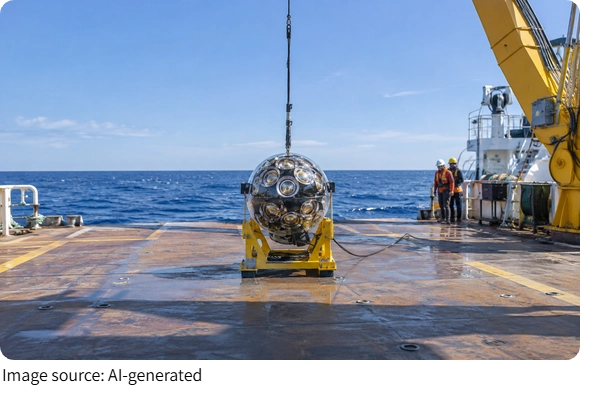
The achievement is especially interesting because it came from a detector that was still far from its intended size. For now, the results show that an observatory beneath the sea can contribute important evidence to some of science's biggest questions.

